The troubles came, I saved what I could save
A shred of light, a particle a wave
1)
Life makes all men the same crazy, the same sane, and the sane and insane spit on each other from across the table.
As I was riding the E train up from Penn Station on my way to JFK, a man gestured to his face.
“Look at this face! They wanted to ruin this pretty face. And believe me, those touches they are giving on the street aren’t loving touches.”
The passengers on the E clustered near the door.
“See these marks?” He gestured to his face, asking the woman sitting near him. “Are there marks on my face?”
“I don’t see anything.”
“Not right here?”
“Looks fine to me,” the woman said.
The doors opened at Seventh Avenue. More people got on and clustered near the door. The man turned from the woman to face them.
“PIGS YOU’RE ALL PIGS!”
At Lex and 53rd, most everyone piled off to try to catch the uptown lines. Some lingered as far as 1st ave. The train was almost completely empty by the time it had passed the final Manhattan stop. The man now sat next to me. We rumbled through the tunnel, up onto the bridge over the East River into Queens through stands of old factory buildings and condos hugging the water.
“This isn’t a sight for children. I don’t want my kids to grow up like you. I’d never want that,” the man said to me.
He was right. I leased apartments for a living. I got shit faced once or twice a week and lived poor because it was the only way I knew how. I dreamed wrong like people said. The man on the train obviously also dreamed wrong. He fed his anguish on me, like I fed my anguish on my mother.
I thought of what I could tell the man. The words came out with an effort, as if I needed to partially vacate my body in order to impart a kindness.
“Life is hard,” I said.
“I want to die everyday, every moment,” he said.
I wondered if he was sincere. When I said those things to myself, it was always a form of beseeching an aloof God. I had visited the man’s head space many times, like a diver, looking around at the flora and fauna of that dark aquatic trench, trying to find something to redeem the years of suffering. But there was nothing there. So it was all a waste, a tragedy.
The man sat next to me in the empty train car. I avoided eye contact with his reflection in front of me. The train ground along the E-line like a knife on a whetstone. I felt sober, hadn’t had a drink for a couple weeks. All that year I had been having a reoccurring dream in which I thought I was a younger man, sometimes 20, sometimes 30. I awoke from the dream realizing that I was nearly 40. Time was the trauma and we were all marked.
The man disembarked a few stops before me. I got off at Sutpin to catch the air train to JFK. It was a stormy day in late November. The rain blew my big golf umbrella inside out by the post office on 34th street. I lingered around the mailboxes trying to decide if I should mail in my lease renewal. I couldn’t decide to leave New York, this place where I had suffered for so long. But I was afraid of a greater suffering elsewhere. I put the renewal in my backpack to take with me to Europe.
Back on the street, torrents of ashy rainwater overflowed the curb. Junkies gabbed high on methadone in the window of the McDonalds as the city went about its business. Old, indifferent stone darkened in the rain. Leonard Cohen was a month dead. My friend Greg who introduced me to Leonard Cohen had died that same November, but at the time I didn’t know.
On the concourse in JFK, a cup of coffee in my hand, I hummed the opening notes to Suzanne, and after I stopped, the chords rattled around my brain getting louder and louder.
2.
I first learned about Leonard Cohen when I was 20. Greg inducted me into his greatest hits album. Mostly the older stuff. We sat in my father’s place, the upper floor of a Victorian in Berkeley. We fed the album into the CD ROM drive. Suzanne. I liked it right away. The songs of a slightly sleazy young man thwarted from a deeper vital experience by his own prodigal nature, searching for another path to redemption. Looking for a loophole.
Leonard grew into a back ally Orpheus who knew he would look back, crane his neck again and again, but he also knew that his sorrows were as lovely and interesting as a dead end alley slick with rain and neon. At the time though Greg and I processed the younger Leonard in a much simple way. We were drawn in by the soft chords like the laughter of a beautiful lady and mesmerized by visions of the world we had only just entered. Leonard sang to us.
Later Greg followed me out there to Portland. I’m not exactly sure why. Maybe because he couldn’t find work. Maybe because he wanted to leave his girlfriend, was lost, wanted to be elsewhere, to chase the dragon of our experience riding trains in eastern Europe, talking to beautiful and somber young ladies, getting drunk on cheep beer. Or he was running away form something. Or maybe it was something else entirely. A quest to be forgiven for who he was. In other words, a loophole. He found a kitchenette in an old subdivided house owned by an ancient and extremely friendly Bulgarian woman named Majorsky.
I was living with PK in her house with the two skiddish white dogs, taking pointless college classes, going through the motions. The things I really took seriously were sex, loneliness and a desire to be far away from where I was. One day Greg came over from Majorski’s and played me Songs from a Room. Some of the songs meandered through a residual mediocrity, in transition, chasing the dragon of lost youth, but they contained the same truthful sadness. The ideas made sense although I would only allow myself to unpack them years later as I searched for my own personal forgiveness. Biblical ideas like the Story of Isaac, The Butcher. I didn’t unpack the strange 60’s coarseness of Seems So Long Ago, Nancy.
We stole bottles of wine from the grocery store and watched old Igmar Bergman movies.
Then one day Greg got tired. Life in Portland didn’t take. He returned to Texas to stay with his parents. I compartmentalized Greg. I put him out of my mind. He had come west, feeling his way through blindfolded. I clung to the delusion that I was going somewhere. Greg was a wayfarer and a sad jester and wandering would-be artist. The burden of the failure I read in him was extra weight in a situation in which I saw no way of carrying my own weight. I needed to travel light in my hopelessness, with no companions to remind me of who I really was or could be.
A year later, living with my mother and waiting to ship out for the Peace Corps, I bought the Leonard Cohen Songbook. My mother lived poor but mostly unaware of the true extent of her poverty in the top story of a rundown house. I made 6 dollars an hour at the dry cleaners down the street standing around all day draping shirts with plastic covers and trying to learn the old cash register. The register was a beast I couldn’t tame that selectively opened its maw for me and spat out fictitious receipts that might have made me look like I was skimming. The only other person working there was a chubby lady with thinning hair who drove all the way in from another neighboring town to scrub stains all day for 12 dollars an hour. The lady and I were the same casualties of the miserable work.
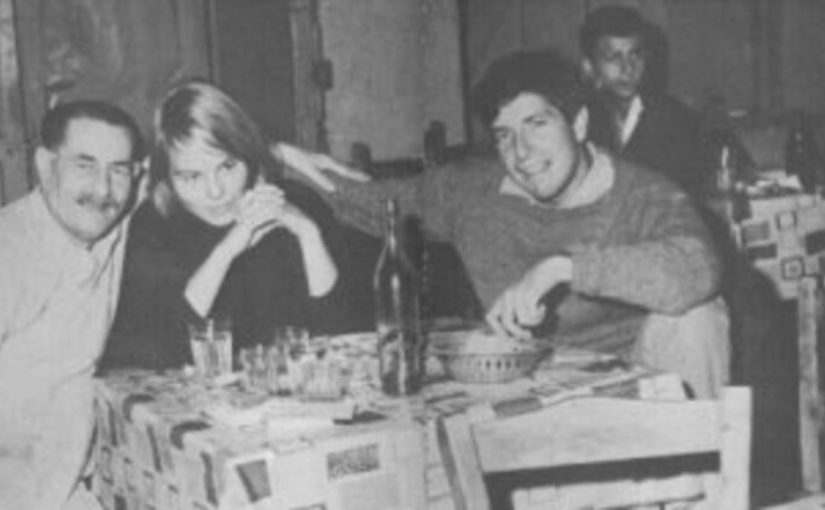
At closing time, I rode my undersized bike home to peruse the songbook. The first dozen or so pages were these black and white pictures of Leonard, where he was just a little older than I was and was living on the Greek island of Hydra with a beautiful blond Norwegian woman. The Marianne of the song. Leonard wore a Greek fisherman’s cap in some of them. He wore a self absorbed mustache. He picked into an old typewriter down by the harbor, his shirt off, the sun on his back. He sat in a cafe before bottles of wine, or outside with a group of friends strumming his guitar. The photos meant a great deal to me. The Leonard Cohen Songbook was the ultimate escape.
My problems with the cash register continued. I just couldn’t wrap my head around it for some reason and made mistake after mistake, offsetting the daily balance by 5 or 10 dollars. My firing from Cory’s Fine Dry Cleaning gave me a chance to practice. The Leonard Cohen songs I was trying to learn were sinking in deeper, as I dreamed myself into the old sun-cracked world of another person. I stole a canister of expensive pomade and slicked back my hair. My hair did not hold the dark sheen for long but rebelled against the pomade and poofed out making my red head look extra large and waxed. I was hopeless. At night I went out on the town to try to talk to young people hanging around dive bars. During the day, up in my mom’s tiny apartment, I tried to learn how to play like Leonard, but I couldn’t move my fingers fast enough. I tried to sing like Leonard, but I couldn’t hold a tune. I strummed and howled and dreamed about growing into the life of a completely different person. Not anyone in particular. Larger than I would ever become with a different bone structure and an important but pointless job. What I thought a man was. A redeemed man.
Over the next 15 years, I waited for a miracle, not realizing the daily miracle of a place to go at night. I couldn’t operate a cash register, but I never became a homeless train raver living in a men’s shelter mission down by the waterfront. I never robbed. I never slept with another man’s wife. I always seemed to have a couple hundred left in my bank account. I always seemed to have a room. In all those rooms I sang another man’s songs.
Once I saw Leonard perform at Barclays in Brooklyn, an old man on a distant stage. At the time I was 32 and living with a Kurdish family on East 18th Street in Flatbush. The mattress I inherited had bed bugs. In the morning we dined on raw honey and fresh bread. At night the Mr. Softy truck parked itself outside of my window. I sang One of Us Cannot Be Wrong over and over as I passed through the old Victorians of Flatbush, crossing Ocean Ave. to East 18th Street approaching the Mr. Softy Truck. In the morning the Kurdish family brought out the bread, cheese and honey (they owned a restaurant). They were a family of academics and intellectuals just as far removed from the center of American society as I was. They sought redemption in a different way than I did.
Leonard put out a couple more albums and died. I went away and then returned again to Brooklyn to other shabby rooming flats full of strangers and bugs. The songs I sang to myself began to unfold revealing my own smashed hopes of entering the life of another man, the man from the songbook, that sun-bleached island. The man with the woman. I bought a ticket. I’d go to Hydra. Maybe I’d meet others like me and they might help me understand my own true value, if I had any, what I was good for, why I felt so unworthy of everything and everyone.
Tickets were cheap to Slovenia. Why not start in Ljubljana. I’d approach Hydra as a pilgrim, traveling slowly overland as I had always wanted to travel, chasing the dragon of another man’s youth.
3.
On the platform at JFK the hot cup of coffee irritated the dyshidrotic eczema on my hand. I swallowed it down feeling it rake my insides. I sat for a little bit watching the raindrops on the plate glass. I think I first saw the man while boarding. We recognized each other 8 hours later as passengers of the same flight disembarking the train from Schipol to the center of Amsterdam. It was still dark out. I had a day to spare before the connecting flight to Ljubljana where I would begin my journey down through the Balkans. The man was dark, handsome and soft spoken.
“I’m going home,” he said.
“Do you live in Amsterdam?”
“Sweden.”
“How did you end up there?”
“My wife is Swedish.”
So, he had found a way to leave America for good. This was something I admired greatly, and I hungered to know more. How did this man escape himself so thoroughly? We crossed the cobbles and the tram lines in front of the train station, the cobbles glossy from a midnight rain.
“How did you get Swedish citizenship?”
“If you can do what they need they will give it to you.”
“What do you do?”
“Computers.”
So, he was an ex patriot, a father and provider pursuing a pointless career. I still wanted to find out more to see if I could do what he did with the computers, but I didn’t ask because I knew that if you can’t operate an old fashioned cash register, you probably can’t learn to program a computer.
We passed through the very early morning with the shuttered coffee shops and the windows with the drapes pulled back. Behind each drape someone had arranged seating for one, folding chairs. Chairs for hookers. The lit windows of sex shops displayed sex paraphernalia.
“I thought I might check out the red light district,” I said.
“This is all more or less the red light district,” he said.
It was as if internal struggles, some festering doubt, quieted the man. We walked along the canal, the water black in the early morning, the cobalt blue sky silhouetting the gabled canal houses.
We passed the curtained storefronts. I was waiting to see the women, but now all the storefronts were empty. There were various masks in the sex shops. Mouth attachments, like adapters, dildo attachments, funnels, all manner of contrivances.
“The Brits come and actually make it into a communal thing,” the man said. “One of them goes inside, and the others wait outside, and then afterwards they cheer and pat him the back.”
The man said the people in Sweden were cold and distant.
“In Minnesota you can literally, go out in the evening, go somewhere, and someone will talk to you,” he said.
As he spoke, I found myself ever more willing to believe in this literal truth about Minnesota. Dawn broke and the canal water went from black to a murky non color. We ducked into the Bulldog Coffee Shop on the canal. There were two women working there, one tall and blond, the other short and dark. I thought maybe they were part time prostitutes. They had sleek pressed hair like wigs, slender tanned bodies. The tall blond woman smiled. For a moment, I wished her smile was more sincere. Men fled their mothers to all the ends of the earth in hopes of being misread by these women. We sat at the circular wooden table in the window. The man began rolling a joint.
Sitting in the coffee shop window, I realized I couldn’t stand the man, so I said goodbye without going through the formality of asking for his contact details. I walked out into the very early morning, the windows in the red light district slowly filling up with beautiful ladies.
4.
Oh the sisters of mercy they are not departed or gone
They were waiting for me when I thought that I just can’t go on
A few weeks before I departed, I went to a birthday party of a young woman where I lied to another young woman about my political sympathies. I didn’t want to spoil the conversation. I didn’t want to tell her I was afraid of dying, of my mother dying, of everyone dying. Not even the hope of a love that would replace my mother could heal the fear. Instead I lied and told her that I was a member of The Green Party.
We stood around in Lillie’s in Manhattan. I was rarely invited to parties and when I was, I always assumed that I was a charity invitee. Even so this young woman wanted to create a connection, but I did not want to form that kind of connection with her because I did not want to press my naked body against hers.
Several days before I departed for Hydra, I saw her again in my neighborhood in Brooklyn. She was riding past on a rusty vintage bicycle, wearing an unusually large bike helmet and a cautionary vest, a sandwich flap, the kind flaggers on the highway wear. She passed without noticing me. A genuinely good person. A woman with a father. A man with a mother.
I exited the coffee shop and meandered down the canal. Hookers filled the windows of the Red Light district. These ladies escaped from their mothers and fathers and now lived in free twilight.
I passed a woman in a nursing outfit. She opened the door to her vestibule. She gave a commanding little shout of some kind. I passed a woman sitting on a swing wearing a cocktail dress in the second floor window. Like a fancy date. Down an alley a handsome young man pressing himself up against the glass, mocking the prostitute who mocked him back by pointing to a drunk leaning up against the opposing brick wall his legs dangling into the street. “There’s one of yours over there,” said the lady.
The drunk, possibly Russian, propped up against the brick wall, his legs dangling into the street, praised a passing man wearing some sort of bronze and gold two-tone polyester suit. “Beautiful suit sir! Beautiful trousers!”
The cobbles clung to the low sky. Cold and hunger, poverty and sickness, billowed from my crusty leather jacket. I bought it years ago in a thrift shop for 50 cents. On the main commercial arteriole, I stepped into an H&M and I bought a big blue scarf. I wrapped it around my neck and felt a little better. The temperature had dropped since dawn broke. My right hip was acting up. I wasn’t used to walking around all the time with a backpack. 18 years had passed since Greg first played Suzanne to me. This entire trip could be viewed as a record of the ramifications of that moment years ago, I thought. All it takes is one song to completely spoil a life, or to redeem it.
Back at Schipol I took a four hour nap on the floor and then went to the gate. An attractive blond woman sat down next to me. She looked back at me, wondering why I was looking at her. She had a Turkish passport. There may have been other excuses, but travel was always to find a woman like this one in the faces of passing women. I turned away.
5.
On the outskirts of Ljubljana, the trees held the smoke of the valley in their branches colonized with raven nests. The air porter dropped me off beneath the Kafka lamp light, a crossroads of large shrubs and middle European houses. After dropping my bags, I wandered down to the center. I don’t remember much from the first night there. Down on the central bridge a man played the hammer dulcimer. A homeless man with a purple swollen face panhandled against a wall on the crowded mercantile corso. The same bra advertisement adorned all the tram stops. The bird boned Intimmisimi bra woman. Her small red bra pushed against her small dark breasts. Looking down the street passed all the tram stops and storefronts, I saw her in quintuplicate.
The woman working the desk of the hostel was practically a facsimile of the Intimissimi bra woman, but 20 years older. Her face was chiseled perfection, the kind gestated by the long centuries of strife and sorrow to ironically embody the nobler hopes of people. In the dining area with the big old table and the cabinets full of dishes I talked to a young American student. Unlike the woman working the desk, she did not thrill me. I wanted all women to be the same bra woman dancing in quintuplicate. Conscious of the gathering dust, the plain young woman asked me if the stacked cups were really clean. With every secret request a man places, he grows stranger than before.
“Do you think these cups are clean?”
“They seem to look fairly clean.”
She picked one up, examined it closely. “You never know,” she said. “I’m going to wash it just in case.”
She made tea. She was studying Germanics in Austria.
“How do you like Austria?”
“It’s alright. It’s a very clean and orderly. I like places like that.”
After she was done drinking her tea, she placed a takeout order for Indian food. I thought this was a strange choice, a steaming hot vegetarian meal in Ljubljana. Minimalist and militant, parred down.
6.
Oh, I see you there with a rose in your teeth
One more thin Gypsy thief
Dietrich from California shared the large bunk-lined room and had wild blond hair like bound and dried corn husks. We stood with some others by one of the Gluhwein stands in the center and had an uncomfortable conversation.
“Just so you know,” a pretty young woman said, “everything shuts down this time of the year.”
“Everything?”
“Just so you know. Don’t be surprised.”
She had come up from Albania, Macedonia, and I was going back down the other direction to Greece.
“It’s changed a lot,” she said of FYR Macedonia. She looked down the string of Gluhwein shops along the river. I could tell that she enjoyed describing the transformations of small and broken states.
“Are you from the area?” I asked her. With her square jaw and big bones I thought she could have been a Serb.
“I’m Italian American,” she said and resumed her conversation with Dietrich.
“Well, have a nice night!” Deitrich told me as their crowd pulled away from the gluhwein table.
I followed. Dietrich led the way, his wild blond hair tied in a fluffy pony tail. We wandered passed the train and bus station to a graffiti covered enclave of old log cabins surrounding a dirty courtyard with large artworks. In the first log cabin, two middle aged men danced wildly with each other, stomping and swinging each other by the elbows.
“Bugger dancing,” said a Brit in our group.
We entered another cabin. This one one was quite large with a stage.
“You’ll never get close to nature,” an old hippy singer sang from the stage.
You want to get close to nature?
You want to get close to nature?
You want to get close to nature?
You’ll have to look right up your ass.
I drank glass after glass of cheap wine. A youngish man with beard said some thing. Then he leaned in.
“I’m going outside, I can’t hear my own voice in here,” he said.
I joined him. Outside the young Slovenian smoked a joint and told me that Kurt Cobain could never have killed himself because he wasn’t left handed and he could have never managed to shoot himself holding the gun the way he did. Courtney of course did it. He offered me the joint.
“It makes me paranoid,” I said declining.
“It makes me paranoid too,” he said. “But I’m a masochist.”
He was missing some teeth up front, a cracked pitcher overflowing, watering the earth with hopelessness. He spoke for a long time about his internet poker gambling addiction.
“Ok, I’m going to meet some people,” he said.
I followed him.
He retreated into the neighboring log cabin where the music was much louder than the first three log cabins. Whiskered old men nodded in and out beneath the noise. I followed Igor into another room. He looked around the room and then he looked back at me. I realized that he was trying to get away from me.
A young woman who had attached herself to one of the young men in the group led us back to the castle. The town square stretched out below us, crisp, cold. On the way back, Dietrich said something to me that unfolded his sadness, something about the ugliness of the architecture, the bird shit on an old communist statue, the beauty of his own Californian home, picking peaches in the Central Valley six months of the year, the other six months wandering blind shattered by a love he could never duplicate. The love of a mother for her son.
7.
Jesus was a sailor when he walked upon the water
And he spent a long time watching from his lonely wooden tower
In the morning the beautiful desk lady told me that she distrusted feminism and gave me wine cordial that tasted like the distillation of an entire vintage of grapes. I became euphoric. She didn’t trust the philosophy of feminism either. Halfway to the station, the alcohol died. Thoughts of my mother’s impending hip surgery, my father’s vagrancy, washed over me. My father lived in Oakland where he slept in the bushes by the Jack N’ the Box. The drive through kept him up all night. Welcome to Jack N’ the Box may I take you’re order? Yeah, I’d like a Sourdough Jack and fries.
A Sourdough Jack.
I boarded the train to Reika, drifting off a bit repeating the Jesus Prayer, the Lord’s Prayer, Hail Marys. Have Mercy On Me. I wasn’t religious but for some reason at some point I got in the habit of occasionally filling my tattered mind with these supplicant prayers. What other prayers were there? I didn’t know. No one told me. Two men in their 50s sharing the apartment chattered the whole way, the chatter of people who didn’t read for pleasure. Beyond the window, across the plane, rose some indifferent mountains. Later on I learned that it was the Dinaridis range.
I slept.
Disembarking later that evening, I wandered down the road a ways to the center of Reika. The air smelt like salt and diesel. The industrial harbor abutted the center of town. I thought that maybe the barges and tugs might run aground upon the old corso. I passed a barber shop just closing up. I wanted to get a haircut but whenever I noticed a barbershop it was closing. I ducked into a grocery store and bought a toothbrush.
Down on the cobbles in the center, a vagrant played the recorder. The softness of the air, the cobbles and the recorder music reminded me of an early novella, published posthumously. The air was warm and soft. I slept in the hostel bunk and awoke in sorrow at 2 am. I wrote some heartbroken thoughts to my mother.
I awoke 4 hours later and bought a bus ticket to Dubrovnik. To pass the time before the bus departed, I entered a neighboring Catholic church. I wrote in my Moleskin: Uranus spilled his seed on Gaia, and the desert God felt ashamed. What do I have to do to get your attention, kill myself? Would that help? Asked the desert God.
The bus hugged the coast. Patches of light adorned the old ivory islands. All the villages had the same red-tiled roofs. Stone walls piled for centuries bifurcated the coastal lands. The islands appeared completely empty perhaps containing the skeletons of marooned fishermen, the echoes of old lamentations still whispering in coves. I was on the second day of hangover. I had epic dandruff. The love songs of today were mostly frank post coital brags. There was no longer even any conceited search for deeper connection. After the fish were gone, the fishermen bought taxis and tour vans and kiosks. American boys chanted their venal pursuits through the bus’s speakers.
“Excuse me, would you mind turning down the music a bit?”
“But why? It’s nice!” said one of the drivers.
Bus drivers were all like this.
At a roadside cafe I bought a couple bottles of beer. After I drank them, the empty bottles clinked in the net attached to the seat. We traced the coast passing through the tiny strip of coastal Bosnia before arriving in Dubrovnik. The night was warm and fragrant with mandarins… The night so dark and thick and green. Climbing one of the innumerable staircases searching for the hostel, I stopped to pick a sour mandarin orange, took the orange peels and put them in my pocket.
8.
I asked my father
I said, “Father change my name”
The one I’m using now it’s covered up
With fear and filth and cowardice and sham
When I was in my mid 20s I wanted to travel solely for the purpose of listening to Leonard on the Brindisi Ferry to Greece, Leonard slowly tracing the contours of the earth like a body. In one of Leonard’s song notes, he says that he heard Suzanne sung on a ship in the Caspian Sea. When I was in my early 20s, I wanted to befriend such softly singing men and women on a ship. And many times I tried and after many attempts I recognized that their welcoming softness was really directed inward into the habitable world they had built for themselves. The problem was, Greg and I never knew how to build our own worlds. The softly singing men and women wore the guise of boy and girl, but they were really transiting to mother and father, and growing into the world as it was. I was growing into the world as it wasn’t.
The owner of the hostel, a woman maybe my age, gave me two small glasses of homemade sherry. Constipated up till then, I immediately rushed to the bathroom.
“Where did you go? I know, I know, where you have been,” she said when I returned. “It’s good for the organism, yes?” she poured another glass.
Over the garden and the lumps of Dubrovnik, the Adriatic sparkled. I walked down the endless flight of steps and along the road hugging the harbor before meandering up to a villa neighboring a cemetery full of tall, conical pines overlooking the placid expanse of gold leaf sea. Through the old town city walls at the launch, a few Asian tourists sat around on the wooden pier pillars with nothing to do because the island of Lokrum was closed Sundays and no one had told them the ferry didn’t run.
I clambering on some boulders around the old city walls where men sunned themselves, arguing and cursing, large hairless bellies slick with oil. Lifelong residents of a place that had turned at some point into a cuss. On the way back to the hostel I found a pomegranate tree with pale, small pomegranates, most of them already split open. Eating the sour seeds, I wandered down another limitless stone staircase passed a woman with her child, and back up again, passed the same woman. I was worried that I would frighten the woman, and so I tried to shrink myself into my old jacket until I was nothing but a jacket.
The chemtrail sky darkened and the stars came out. I climbed the steps to the utter extent of the city where the highway twisted along the coast. Crossing the highway, beneath the winter constellations, I clutching at the weeds and wild grass of the hillside, pulling myself up.
9.
My mother was as bent and torqued as I remember her own mother being, like she carried an anvil on her back hammering her into the ground. I told her about my memories of her own mother, my grandmother, but she couldn’t recall how stooped her own mother had become.
A painted lady of a police officer stood at the bus station. She looked like she could have been a fashion model dressed as a police officer for a photo Brooklyn shoot.
Then clenching your fists for the ones like us who are oppressed by figures of beauty…”
.After we crossed into Montenegro, the bus wrapped inland, twisting around a bay sheltered by a wall of steeply rising mountains. I had entered again into one of those childlike landscapes that only exist after you pass over a certain geographical point where the earth itself becomes a genetic memory. Here are the massive peaks. Here are the fairy islands with the little white churches. Here is the village with its peaked rooftops. Here are the beleaguered little people. Here is the old lamentation.
In Kotor, I resolved to climb the steps to the old fortress that led up from the little labyrinth of ancient houses making up the old town. Beneath the steps, a Russian trio, one man and 2 ladies asked me for directions. My passable travelers Russian surprised them.
“Natasha,” one of the women said smiling.
“Blonds, always Natasha,” said the Russian man.
Natasha smiled a faintly plastic surgery smile. The man and the women were together but Natasha was alone. I was going somewhere and so were they. Here, there, everywhere. I didn’t know what to say, what to add to bind Natasha to me in some sense that might create the possibility of a tryst. As I began to climb the steps, I regretted that I did not say anything more to make an additional linkage with Natasha. I regretted it endlessly, my regret spilling into lamentation. The stairway led up to the fortress and deep into the mountains. I passed an old chapel, its insides wrecked, grass growing on the roof. I passed a cow chewing its cud. At the top a painted lady with a selfistick took pictures of herself. Someone had graffitied on a crumbling wall, “I love you Valentina”, and then as I walked along a grated metal rampart installed for the benefit of tourists, I saw the declaration again, this time graffitied higher up. “I love you Valentina!”
On the way down I stumbled into a chamber with dozens of etched names on the wall, hundreds of names written on top of each other, name upon name. The wind whistled through the cracks.
I walked around the old town in circles searching for Natasha, looking into darkened windows, listening for the sound of voices. I passed a hair salon where a beautiful woman stood frozen behind a window. I passed the little church locked shut. I stepped into a bar where a lone photograph hung high on the western wall.
“Who is he?” I asked
“The founder of the club,” said one of the old men of the men. The founder looked like a cross between Stalin and Peter Falk.
That night I ate with some young French tourists in the hostel restaurant. They were cold to me until I mentioned the purpose of my trip. They invited me out to a restaurant, but I stayed played some Leonard Cohen tunes, humming the chords to Suzanne louder and louder, finishing off everyone’s beer.
In the morning I was in a state of nervous exhaustion when we crossed the frontier into Albania and pulled into Shkotar. The people in the street market dressed in used clothes. Poverty and hunger is like a lantern turned on inside a person’s face drawing out the truer ultimate intention. To survive. To kick the can forward to some future point of collective reckoning. To not be lonely anymore. To be worthy. To receive something back for the constant grinding giving. On the old corso I passed a beautiful big women with luxurious, dark hair. She stood at an intersection flanked by a mosque to the left, a newish hotel on the right. Gypsies played in the intersection; a child spat juice out of a juice box into the face of another child. Their mother sat in the sun leaning up against a spackled wall. I wandered around lost for a little while, asked directions from a beautiful young woman working the advertising stand in front of a cell phone shop.
“You want mobilni?” she asked.
She had thick brown hair like the rest.
10.
From the cold of my bunk I watched a Japanese man reconfigure his possessions, which were stacked neatly at the foot of the bunk. He was small with a goatee, balding at the top of his head, but with long hair reaching the middle of his back. That night I dreamed that our technology created us, working behind the scenes, a living entity wearing a disguise of subordination.
The following morning, Arnold showed me the bikes. Arnold was French and the same age as me. He traveled the Balkans by bicycle pitching his tent in the hills. When he needed a rest he volunteered at hostels like this one.
“Would you like to see my bike?” he asked me.
He was like a little boy. Somehow he had slipped through the crisis without really experiencing it. Or he had let it wash over him, purifying him completely.
“Yes.”
“Come.”
I followed him through the little garden to the side of the old wooden house.
He showed me an old Japanese mountain bike he had found on the street in Belgrade.
“Someone had left it there on the street, but I thought it still had some more use and so I fixed it. The most important part is the seat,” said Arnold. “It must be soft because you will be sitting on it a lot of the time.
I road an old bike of his down the main drag that turned into the highway leading south. It was chilly out. It was only mid afternoon, but it seemed to be approaching dusk. The old city fortress loomed to the south. I took a right over a rickety wooden bridge into a little Gypsy ghetto. I took some photos of Gypsy boys. A snot nosed boy pushing a stroller told me to photograph his little brother, another malnourished little boy in a stroller. Rounding the curve of the lake, I stopped at one of the restaurants. I had a sip of Rakia and immediately fell into a gloom thinking about my mother.
It was getting dark. I rode back through the Gypsy area across the old wooden bridge onto the smokey road. Several donkey carts passed driven by men out of time.
Alma sat wrapped in homespun wool in front of an old computer where she fretted over the negative reviews of her ramshackle budget hostel. She told me the story of how she started the hostel. Her first husband’s father, an Italian, bought the place before Albania went communist. Alma went live in Italy.
After her first husband died, in the 90s she came back with her second husband and assumed ownership of the house which had been nationalized and had served as an administrative building. She asked herself what she could do with the place and, although nobody understood the concept at the time, she decided to start the hostel.
“They all laughed in my face.”
She lived in the hostel for a while when her second husband Georgio decided he wanted to try to build a hiker’s refuge in the remote village of Valkeryie in the Accursed Mountains of northern Albania. The village was only accessible by a precarious road hewn into the wall of a ravine. That is where Georgio’s car laden with supplies plunged off a cliff. Alma had been alone running her hostel ever since. She sat at the old computer fretting over the complaints of German tourists.
In the morning I visited the little neighborhood regime jail down the street from the hostel. I sat in the darkness of one of the cells and shut the door behind me. A former inmate of this jail gathered quotes from literature on scratch paper he hid in his shoe. They displayed the scraps under glass in a little museum. Little messages to his family that were never delivered but were found later.
“For the sake of love, don’t worry about me,” one of them read.
The messages were all the size of the slips of paper in fortune cookies. Smuggled fortunes.
I wandered in and out of the abundant used clothing shops of Shkoder looking for a hat so that I would be warm enough to continue on, but all the hats were too small for my large red head. Albanians wore the clothes of yesteryear sold from hole-in-the-wall used clothing stores run by men and women swaddled in homespun clothes. The hand-me-downs of northern Europe. Walking down the main drag I saw an old lady sitting on the sidewalk on the corner selling beautiful hand knit socks. By a chain link fence near the permanent Gypsy encampment men milled around sacks of uncured olives selling parakeets from cages tied to telephone poles. I bought a small bag of cured olives and walked down the old main drag spitting the pits into the gutter.
I got a haircut. The barber had a hard time figuring out how to cut my hair which stuck out unwashed at all angles. Another barber approached to consult. The man getting his haircut next to me offered his input. He spoke a completely garbled mixture of English, Italian and German. A third barber approached and argued passionately for a certain approach. He had several teeth in the front of his mouth overhanging his lip. The work was done mostly on the sides and in the back. After I ate some burek, on my way back I passed a young women on the street, 18 or 19. Her beauty was a house fire.
The frontiers are my prison…
I grabbed the bus to Tirana with the Palestinian war photographer Ravi. We spent a little while wandering in and out of pharmacies trying to find his anxiety medications.
“I used to hate Jews,” he told me. “But now I love everyone.”
He was on a complex cocktail of benzos and anti psychotics sold freely over the counter in a state that had yet to internalize and commodify mental health narratives.
We passed little farms and houses with lots of TV antennae and satellite dishes sticking out, big metal gates, fruit arbors, chaotically plotted landscapes, shepherds with sheep.
Ravi looked like Dionysus. Caucasian features, kinky afro hair. In the hostel in Tirana, he mentioned the beautiful women he had already met in Tirana using his telephone. He managed to harness the technology as a gateway to woman, and the women wanted him back. He called one of them Rapunzel because she had long blond hair. There was another woman, a lawyer who was sending him messages. She missed him. She wanted to meet.
Tirana had the same tired and used feel, but the street cafes in the center were packed and cheerful. I visited the Albanian historical museum. Classical art, pottery, early Christian mosaics. Three cheerful piss poor women around my age mopped the huge marble floor of the lobby.
Eni the desk girl at the little hostel with the porch and the garden put on Sounds from a Room and gave me some homemade beer and rakia. I had a hangover. The night before at the bar across the street Rocky Four played on the old color set wedged in the corner, and I sat drinking rakia after rakia. Sylvester Stallone did laps in the freezing Siberian tundra.
“Every garden in Tirana has a mandarin tree and an idiot,” said Eni’s boyfriend. He looked like a partisan.
Eni had long brown hair and a pierced tongue with a plastic lavender stud. She spoke of journeys west, to Paris, London and New York.
Our bus inched out of Tirana. Three wild haired sisters sat near me in the back. One of them bought dried herbs from a man in ragged old clothes peddling grasses up and down the aisle. I got out at the border crossing to see if I could find some more Rakia, but I resolved not to because there was no toilet on the bus.
We waited for an hour and a half for the drug sniffing dogs to go through the bus. After we crossed over, I bought a baguette and a hot tiropita at the cafe. I gave the tiropita to an old Albanian guy who had given me a cigarette while we waited at the frontier. For the remaining 9 or 10 hours, the driver played endless episodes of an old Bulgarian variety show called Al Pazar. The discordant sounds of canned laughter, whistling and cheering piped in from every speaker on the road to Athens.
All bus drivers are the same.
12.
My childhood friend Garlington was in Rome at the time preparing to photograph the actor Defoe. I wanted to sit with Garlington and Defoe in a restaurant. As I traveled I constructed an elaborate fantasy around the meeting. I began to plot an escape from Greece. The ferry from Patras to Brindisi to meet with Garlington and Defoe. Years ago I had taken such a journey across the rainy winter sea. Soon after, I discovered Leonard Cohen who encapsulated those earlier experiences in song, torturing them to a kind of perfection in the barren landscape of my misspent life.
I sat in the cafe by the bus station figuring out how to make my way to the Pagration hostel where I had stayed as a student all those years ago. At the time, there had been an Australian man who casually asked me and others to exchange massages with him.
“Want a massage?” he had asked everyone in the hostel and everyone had decline his invitation, fearing his touch.
There had been a Dutchman around 30, which seemed old to me at the time. He was on his way to Crete to visit Kanzannakis’ grave. We sat in a coffee shop in the city heights. With uncommon attentiveness, he listened to me convey my loneliness. He spoke of books I hadn’t yet read, Zorba the Greek, the Last Temptation of Christ, but he did not mention Report to Greco, which was the one I truly fell in love with years later.
I took the metro to Syntagma, walked up the steps and crossed the street to photograph the lazy dogs in front of the presidential palace. I walked through the neighboring city park like a little park in Cairo. The abundant palm trees and stray dogs and old men hands behind their backs clutching tavli made it seem Ottoman. Across Vassilissis Sofias Avenue, I walked up the steps leading behind the old Olympic stadium. A day had passed and in that day all my secret doubts had blossomed into the life of a dour man. A deeper exhaustion taking precedence, walking no longer tired me as it once had. I took out my moleskin and wrote: Some men don’t know how to make themselves useful.
A young man named John checked me into the old Pagration hostel on Demarius where I had once stayed. In the Plaka by the Ancient Agora, I wandered down an empty alley taking black and white night shots with my camera that came out blurred unless I was very still. I wanted to send these black and whites to Garlington. Down a black and white alley, I came out in the Indian section of town. Dark, south Indian men clustered beside graffitied walls.
I passed a wedding in Exharxia. Men in uniform stood on the steps of a church hoisting swords for the newlyweds to pass under. I thought I might drop dead in a few moments. A few seconds. Here it comes, I thought.
I was working on several days sobriety, but I contemplated ordering wine at the cafe by the central square in the Kolonaki. Instead I sat with a 3 euro coke and watched the women pass. As artfully hungover as the young people seemed, Cafe Peros across the path was full of the same eternal old men you see everywhere in the Balkans playing backgammon.
At last I started walking home, passed the Mr. Vertigo wine shop. Lots of copies of Paul Auster’s Mr. Vertigo stacked in the window. Coincidentally, this book had made a great impression on me as a teenager. I couldn’t put it down. I stepped into the wine shop to ask why they had named the shop after this novel, but the lady working there didn’t know.
13.
The groceries in Athens were very expensive. With the economy, I couldn’t understand how these people could survive unless they all lived crowded into the same apartment. I bought a small loaf of bread, some tomatoes, some feta and a small bottle of retsina and brought it back to the hostel. The coughing woman from the neighboring room was in the kitchen coughing over a pot of simmering vegetables. She had long mousy hair, a red nose and wore purple velour pajamas. She seemed to ignore me.
“Are you sick?”
She suddenly opened up completely fearless. Marlis told me her name.
“Just a cough,” she smiled, spoke with a dense German accent. “But I know what to do, how to heal myself with herbs and tinctures.”
She stood there smiling at me. I asked her about her travels.
“Oh, I have been staying here for some time, I like it very much, it is a very good place I think, the people are good,” she said of the youth hostel. “I have been traveling for quite some time and am very happy to have found this place.”
Like many schizophrenic prophets you meet, she concealed her past for me, too sorrowful and too insane for the layman to grasp. The Pagration youth hostel was mediocre to poor, drafty, chilly. They put all the winter guests in one or two small rooms to save money. The open courtyard space was gloomy and dark, with a couple old metal tables set up, some old yellowing tourist posters stapled to the walls.
“Can you open this bottle?” Marlis asked me.
She had a powerful herbal smell.
“That cough sounds pretty bad.”
“Oh this, it’s nothing.”
She moved among her pans simmering on the hot plate beneath the flickering kitchen light. I opened my bottle of retsina and let it elevate me for spare moments. We ate in silence.
“Sometimes I like to take a walk after I eat,” said Marlis.
We walked down around the old Olympic Stadium, across the street into the park and down through Syntagma into the vacated and dirty night, the darkness amplified by pollution, blindness encroaching. Marlis coughed. She walked extremely fast, her entire body used to the motion, an endless aboriginal walk about.
I could hear her coughing all night long. In the middle of the night or very early in the morning, a man entered and after fumbling around a bit, climbed onto the top of the bunk next to mine.
14.
I woke up around 2 pm to watch the slight bald man, around my age, approaching 40 who seemed to have all his possessions neatly arranged next to the lower bunk of the adjoining room, sweep up around my bunk. Although I was still in bed, he scolded me for leaving the door open and letting the heat out.
“Heat is expensive, never leave this door open, do you understand?”
Later, on my way out, he passed me in the hallway. I tried to make conversation.
“Me? I live here, volunteer. Yes, I studied economics by trade but here life is shit,” he said. “But you, look at you. What are you doing here? Why don’t you go and stay somewhere nice? This isn’t a nice place. Stay someplace in the center, in Monastiraki, meet a girl.”
“I’ve never had much luck with the girls.”
“Funny, you’re funny” he said. “Why don’t you go and have some drinks, go down to a bar, find a girl, nice American boy like you.”
“Is that how it works?”
We stood in the drafty courtyard. The day was already mostly wasted. I walked down to the Hotel Chelsea coffee shop with the pictures of Leonard Cohen on the wall. It would have been a good place to discuss my journey with someone, but people sat in small inward looking clusters over espresso discussing matters. I went to the supermarket, bought a bottle of wine. Back at the hostel, Marlis was cooking in the kitchen.
“Oh you are back!” she said. “I am cooking. You must have some.”
And then she went on cooking in silence. I began drinking my wine. We ate her vegetarian meal in silence. She began washing the pots and pans. I watched her.
After a while she asked: “Would you like some tea? It is orange mandarin, quite good, I make it with a little honey, very healthy.”
We sat sipping the tea. Tary came in and began cooking some chicken his friend at the store had given him.
“What are you doing here?” he asked me. “Go out, go have fun, meet a girl.”
Instead I walked down to Platea Varnava and sat in the ouzourie with a couple old men who sat alone devoured by winter blindness, starring into a void.
15.
“What are you doing here Marlis?” I asked.
“It’s a long story.”
“I’m curious.”
“I came to just help some people.”
“What people?”
“Oh, you know, just some such people.”
“Help with what?”
“Oh, with some such things.”
“What things?”
“Oh, with a business.”
“What sort of business?”
“An herbal business.”
“Who were these people, your friends?”
“Only some such people. They wanted to start an herbal business and they knew that I know about herbs and things. But when I got there, they took my money and I was left with nothing,” she said.
“Where was there, here in Athens?”
“An island.”
“Which island?”
“Oh, just some such island.”
“But why did they cheat you?”
“It’s a long story. They heard lies about me from other people.”
“Which other people?”
“It’s a long story.”
“What happened to you?”
“They wouldn’t let me leave the island. Whenever I tried to board the ferry, they wouldn’t let me leave.
“Why didn’t they let you leave?”
“Some things I was saying. Truthful things about them.”
“Who?”
“The people in Germany.”
“But what did you say?”
“Just some truthful things.”
“And the people in Germany didn’t let you leave?”
“They told the people here and they didn’t let me leave.”
“So they kept you prisoner on the island?”
“Yes, I was so happy when they finally let me go. I think this is a good place.”
We stood in the dark kitchen of the Pagration youth hostel.
“You mean Athens?”
“No, this hostel, I like it very much. It is quiet and they don’t bother you. Can I ask you a favor?”
“What?”
“I need to collect some money at Western Union but the Africans at the front want to hold my passport, is that normal?”
“I don’t know, I’ve never used Western Union.”
“Can you come with me?”
“I don’t know Marlis.”
Months later I contacted Tary. He was staying in a youth hostel in London at the time, his possessions piled at the foot of his bunk. I asked him about Marlis.
“Tary, do you know whatever happened to Marlis?”
“Whoooooo?’
“That German woman who coughed constantly.”
“Whoooooo?”
“You mean you don’t remember?”
“Marlis? I don’t know who is this.”
“That German woman who lived in the neighboring room and coughed constantly. Marlis.”
“Whooo?”
16.
“Can you stay in my room tonight?” asked Marlis. “This man comes home late and I am afraid of him.”
“The Greek musician?” I asked.
Every night after playing his accordion in bars, the musician came home at two or three in the morning, creeping in as quietly as possible.
“Yes, but I am afraid of him. Can you come and stay in my room?”
From the top bunk in Marlis’s room, I could see her as she lay in a pile of herbal fragrance reading her bible which she said she believed every word of..
Months later I examined the photos I took back then, mostly black and white disasters I wanted to send to Garlington. Among them, I had a number of pictures of myself. I was fat from all the alcohol and the pastry diet. Puffy, red, tired looking. Fat assaulted my cheeks and chin. No matter how I probed Tary, he did not remember Marlis, the herbal-smelling woman with the violent cough.
“Marlis, aren’t you afraid?”
“Afraid of what?” she asked while reading her bible.
“Poverty?”
“Christ was so poor he had to borrow a donkey,” she said, closing her bible. “Now it’s time for sleep.”
17.
A man brought me an ouzo and set it before me like he was serving a ghost. I was growing out of my ignorance and into understanding. I had no time for the strong, only the sufferers who lived at the bottom. I looked up from the old wood table of the ouzorie and into the milky mirror. It all boiled down to the same thing. Sadness was truth.
I crossed the street from the ouzorie to the pub. There were some attractive women at the table in front of me smoking loose leaf tobacco. Everyone in Athens now rolled their own cigarettes because they smoked a lot and couldn’t afford to buy packs. My liver throbbed, or maybe my gal bladder or intestines. I wanted to buy a homespun Navajo coat. That’s how it begins. I was remembering how to breath those days. The guy next to me was on a computer, but I had found release in another sort of computer. My brain. I wandered out into the night. I visited the place where I once lived as a student, and then the pub down the hill from there. It’s such a perfect day was playing. Then Neil Young. Why exactly was it better to burn out than to fade away? Then Rock n Roll Suicide. Then So Long Marianne.
Oh we met when we were almost young
Deep in the green lilac park
18.
“At first you must leave everything that you cannot control. It begins with your family and soon it comes round to your soul.’
In Piraeus people huddled at the counters of the cafes flung wide open in the freezing cold, cupping their coffees with icicle fingers. I needed to remember, never order coffee in Europe, always espresso. There were old tourist offices and rundown hotels and corner casinos all shut tight.
Down at the waterfront, I passed the ticket sheds. In the drafty sheds people dressed in threadbare company uniforms sold ferry tickets. Hellenic lines, Minoan Lines. I bought a ticket from an old man with a weathered face smoking a cigarette who looked like the actor Robert Shaw. He looked up at me from inside his chilly shack like I wasn’t a human being at all.
I ducked in at a church, the morning ceremony in progress. As I was passing over the threshold, a woman wrapped in a red shawl highlighting her rosin cheeks, her palm cupped upward as if to hold a few drops of rainwater, pleaded with her eyes. Inside the dimly lit cathedral, congregants readying to receive the host venerated the icons. Jesus have mercy. A young woman with magnificent hair approached and kissed the icon of St. John. A slightly older woman, perhaps in her early 30s, although dressed conservatively in the mode of a much older woman but also with magnificent hair, approached and kissed the glass covering the St. John icon. I thought about the many lips that had kissed the glass. Such a thing would be inconceivable in America.
19.
Show me the place you want your slave to go
Show me the place I’ve forgotten I don’t know
Show me the place where the word became a man
Show me the place where the suffering began
As I embarked I hummed the opening chords to Susanne, the familiar progression of 4 notes. I hummed Suzanne mostly when I thought of escaping to another country where a beautiful woman might mistake me for someone else. I had hummed the notes throughout my journey, and now, near Hydra, the hummed louder. As the boat pulled away, I hummed as loud as I could. I began to shout the chords.
The harbor in Hydra was mostly empty except for a couple restaurants at the landing where some people huddled beneath blankets and space heaters. None of them seemed to be obvious Leonard Cohen acolytes. I walked over the polished cobblestones passed these huddled and incurious people waiting for the daily ferry to take them to the Peloponnese.
The village spread out to the north and the south on the slope rising into the pine forest. Along the promenade, the shops were all shut, their awnings drawn up. Some men loaded donkey’s with boxes handed up from a little boat. I wound my way left through the silent alleys passed several shut hotels. I passed a big-boned blond woman walking the opposite direction.
“Do you know of any hotels?”
“Yeah, sure,” she said.
After putting down my things, I later saw the woman who had referred me the hotel. She was sitting at one of the outdoor bars smoking.
“It’s freezing,” I said, approaching her.
“Yeah, it’s like Hamburg,” she said.
We went into the neighboring bar with the football memorabilia piled on the walls along with beer signs and old travel posters. We ordered a couple of ouzo’s served with little ham and cheese servings.
“I wish they gave us chips,” she said.
She was sick, her nose running.
“There is nothing to eat here is why I am sick, I cannot eat the food and have been eating only bread these last few days,” she said in a plodding German accent.
“You can’t eat the pastries either?”
She shook her head.
“Bread and beer.”
“It’s hard in Greece when you can’t eat the pastries.”
“Yes, but it is worth it,” she said. “Did you see how they treat the donkeys here? They treat them horribly.”
“We treat animals too poorly,” she said. Her accent monotonous and pretty.
The waiter brought more ouzo with more of those little ham and cheese snacks that she couldn’t eat.
“What do you do for protein?”
“Semen,” she laughed sadly.
As she told me about the mistreatment of animals, the TV playing beyond her mounted to the wall broadcast a show called ‘animals gone wild,’ which was basically a bunch of different species of animals ripping each other apart.
“I always felt myself alone until I met other people like me, other vegans.”
“You’re a sweet person,” I said.
She blushed.
Later that evening drunk on ouzo and beer, we stopped at the garden wall of Leonardo Cohen’s house with purple flowers spilling over the rock wall, the mandarins and lemons dangling from the branches of old trees. Then we walked down to the harbor.
“I think everything just gets worse. Technology makes things worse,” I said.
“I agree. I think just the same”
“I feel trapped by my life,” I said.
“Me too.”
“It’s hard to describe the sensation.”
“I know,” she said.
“It’s like whatever I will do…”
“I know,” she said as we walked along the harbor. “It’s like whatever you do, it doesn’t matter. You don’t look happy.”
“I don’t?”
“No, you look like you are always thinking, always searching for a solution to a problem.”
“It’s my face. People always read something in my face.”
She had a toothy smile that suddenly flashed over her sad somber face, an archaic Teutonic rebellion from Christian mercy. She had a pierced nose with a bead attached to the ring and lank hair she constantly brushed away. She was my age but looked younger. We marched back to the hotel together and embraced in one of the cacophonous halls of the Hotel Amarilis, before separating to our little rooms.
The next morning, I wandered up to the farthest reaches of the town to where the cobbled road started to climb high into the hill toward the Prophet Elias monastery. The air cooled.
Turning, looking out across the water, the windmills on the Peloponnese had stopped as if time elsewhere had froze. Approaching the monastery, a dog barked at me looking down from the low-jutting flat roof. A monk came to investigate, smiled at me, retreated into the courtyard. When I entered the clean swept courtyard he was gone and the sun baked white stone surrounded by the low lying monastery was empty, the chapel locked.
Down along the harbor, the weather had changed. The old Harlot Aegean writhed. The windmills on the Peloponnese were obscured by clouds. I scoured the town looking for an open shop, but everything was shut, closed for the winter. Some cats fought over scraps by a garbage can on the promenade, and a short-haired dog shuttled aimlessly to and fro and fro, shivering in the freezing cold.
 Show Me The Place